


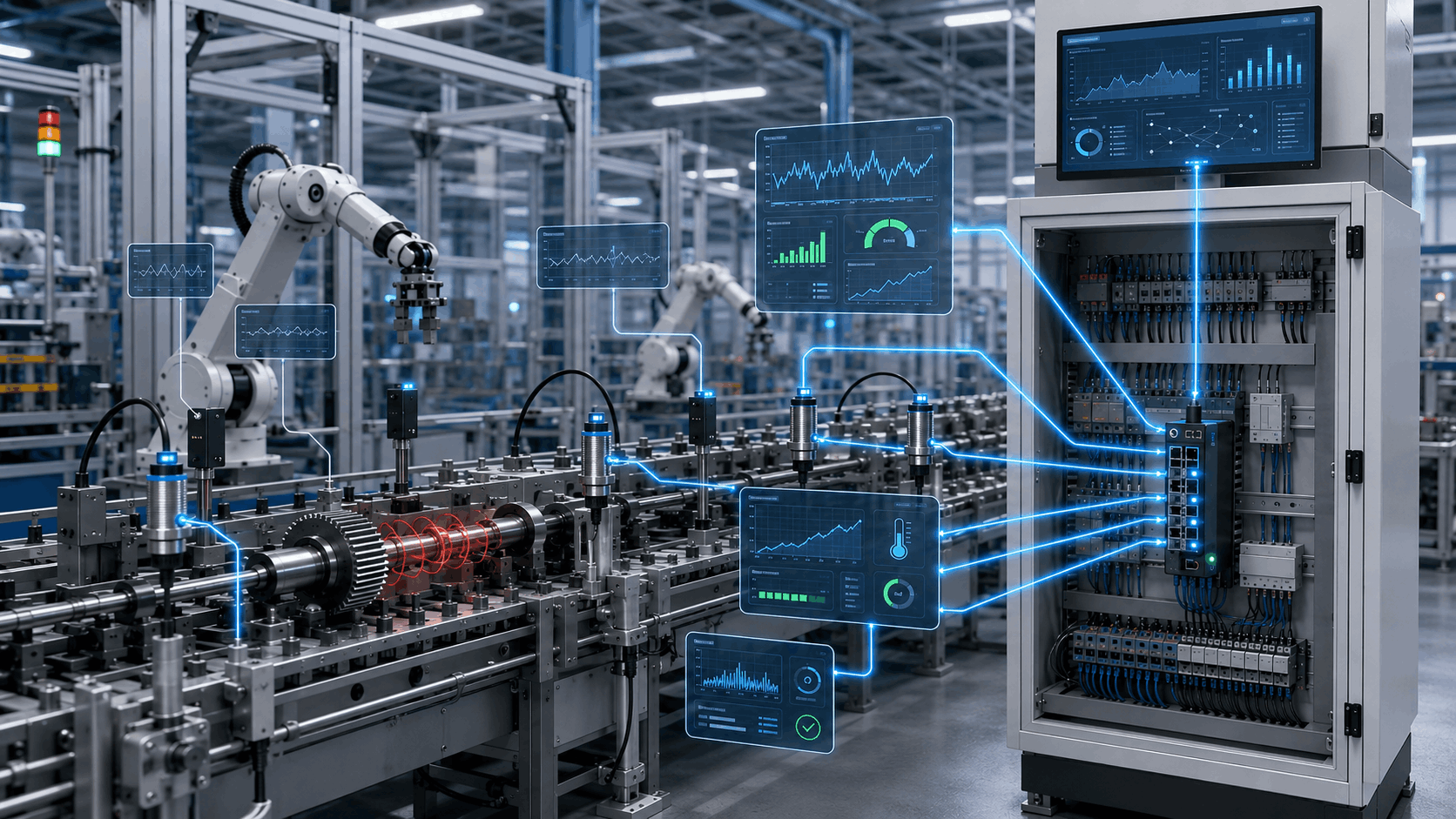
Manufacturers are under constant pressure to improve efficiency, reduce downtime, and gain better visibility of their operations. Achieving this is no longer just about adding more automation, it’s about improving the quality of information flowing from the factory floor. IO-Link is one of the key technologies enabling this shift.
What is IO-Link?
IO-Link is a standardised communication system that connects sensors and actuators to control systems, allowing them to exchange detailed data rather than just simple signals.
Traditional sensors typically provide basic on/off information. IO-Link devices go further, providing:
- Real-time process data
- Device diagnostics
- Parameter settings
- Maintenance and status information
This allows engineers to see not just whether a device is working, but how well it is performing.
IO-Link masters such as the IFM AL1400, SICK SIG300, Baumer IO-Link solutions, and Schmersal IO-Link integration act as the bridge between field devices and higher-level control systems, enabling this data to be accessed and used effectively.
Why Are Manufacturers Adopting IO-Link?
The main driver behind IO-Link adoption is visibility. Many production issues are not sudden failures, but small inefficiencies that build up over time. Without detailed device information, these issues often go unnoticed until downtime occurs.
IO-Link helps manufacturers:
- Identify issues earlier
- Reduce unplanned downtime
- Improve troubleshooting speed
- Simplify commissioning and maintenance
- Support data-driven decision making
As production becomes more connected, access to real-time device data is becoming essential for maintaining efficiency.
Smart Sensors vs Standard Sensors
The difference between standard and IO-Link sensors is the level of information available.
A standard sensor provides a basic signal: something is either present or not.
An IO-Link smart sensor can also provide:
- Operating conditions
- Signal quality
- Temperature or performance trends
- Fault or warning messages
- Device health status
This additional data turns sensors into sources of operational intelligence, allowing maintenance teams to act before failures occur.
Reducing Downtime Through Visibility
Downtime is often caused by small, unnoticed issues rather than major failures. IO-Link improves visibility at device level, helping teams detect problems earlier.
With better diagnostics, engineers can:
- Pinpoint faults faster
- Reduce troubleshooting time
- Respond to issues before escalation
- Improve overall machine availability
This shift from reactive to informed maintenance is key to improving operational efficiency.
Faster Diagnostics and Easier Maintenance
IO-Link also simplifies commissioning and device replacement. Settings can often be automatically transferred to new devices, reducing manual setup time and errors.
Detailed diagnostics help maintenance teams quickly identify:
- Which device is affected
- What the issue is
- Where action is required
This reduces downtime and speeds up recovery.
Foundation for Predictive Maintenance
IO-Link provides the foundation for predictive maintenance by delivering continuous device-level data. Instead of relying on fixed service intervals or reacting to failures, manufacturers can monitor real operating conditions.
This enables early identification of:
- Performance changes
- Wear and degradation
- Abnormal operating behaviour
Predictive maintenance begins with visibility, and IO-Link provides exactly that.
Summary
IO-Link is transforming industrial efficiency by improving visibility, simplifying diagnostics, and enabling smarter maintenance strategies. By turning standard devices into connected sources of data, technologies like IO-Link are helping manufacturers move toward more efficient, responsive, and data-driven operations.
Understanding where you stand and what steps to take next can be challenging, but you don’t have to navigate it alone, get in touch today.