


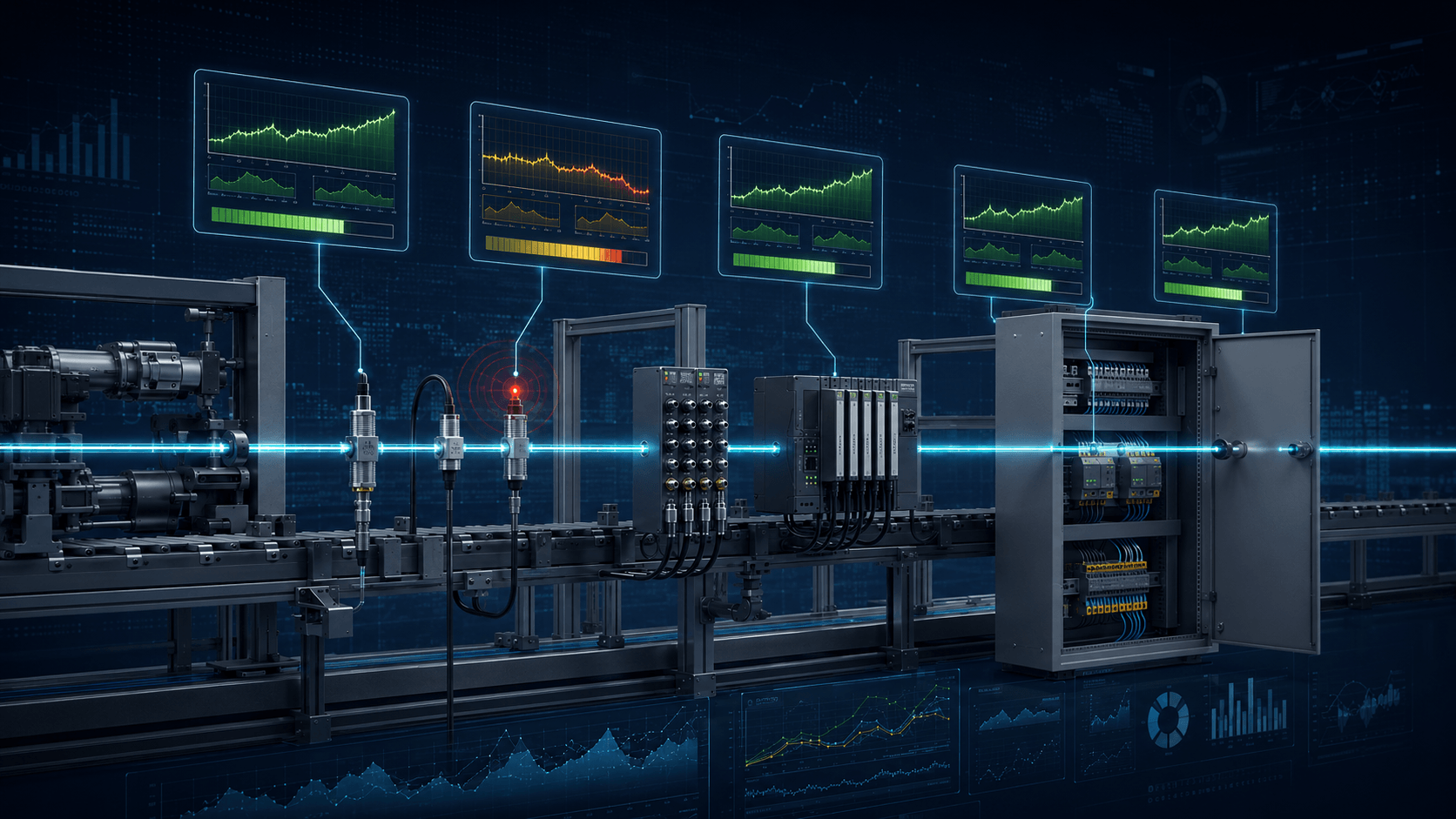
As industrial operations become more connected, the focus is shifting from simply monitoring machines to understanding them in greater depth. This evolution marks a move towards operational intelligence, where decisions are based on real-time data rather than assumptions or fixed schedules.
At the heart of this shift is one key requirement: better data.
Predictive maintenance is only possible when manufacturers have access to meaningful, timely, and reliable information from their equipment. Without it, maintenance strategies remain reactive, often resulting in unnecessary downtime and avoidable costs.
Moving into Operational Intelligence
Operational intelligence is about turning machine data into actionable insight.
Rather than simply knowing whether a machine is running or not, manufacturers can understand how it is performing, how it is changing over time, and when intervention may be required.
This is where connected systems and IO-Link-enabled infrastructure play a key role. Devices across the production environment can continuously share diagnostic and performance data, helping teams build a clearer picture of overall system health.
Solutions such as the SICK SIG300 and IFM AL1400 help enable this connectivity, acting as key components within a broader IO-Link ecosystem that supports smarter decision-making.
Moving Away from Reactive Maintenance
Traditional maintenance approaches are often reactive, action is only taken once something has already failed.
While this approach may resolve immediate issues, it typically leads to:
- Unplanned downtime
- Higher repair costs
- Production disruption
- Reduced asset lifespan
Predictive maintenance aims to reduce this dependency on failure-based intervention.
By leveraging continuous data from connected devices, maintenance teams can identify potential issues before they escalate, allowing for planned and controlled intervention rather than emergency response.
The Role of Device Diagnostics
Device diagnostics are central to predictive maintenance strategies.
Modern connected devices can provide detailed insight into their own condition, including:
- Performance trends
- Signal quality
- Operating conditions
- Early warning indicators
With solutions across the general IO-Link ecosystem, these diagnostics become accessible at control level, allowing engineers to monitor device health in real time.
This level of visibility enables faster identification of abnormalities and supports more informed maintenance decisions.
Improving Maintenance Scheduling
One of the key benefits of better data is improved maintenance planning.
Instead of relying on fixed service intervals, manufacturers can use real operational data to determine when maintenance is actually required.
This leads to:
More efficient maintenance schedules
Reduced unnecessary servicing
Better resource allocation
Lower overall maintenance costs
By understanding how equipment is performing in real time, maintenance becomes more targeted and effective.
Reducing Unexpected Failures
Unexpected equipment failure remains one of the costliest challenges in manufacturing environments.
Predictive maintenance helps reduce these events by identifying early signs of wear, degradation, or abnormal behaviour.
Connected systems such as SICK Connected Devices and IO-Link-enabled infrastructure provide continuous feedback from the shop floor, allowing teams to act before small issues develop into major failures.
This shift from reactive to predictive operation significantly improves reliability and overall equipment effectiveness.
Building a Data-Driven Maintenance Strategy
Predictive maintenance is not a single technology, it is a strategy built on data.
As manufacturers adopt more connected systems, the ability to collect, interpret, and act on machine data becomes increasingly important.
By combining IO-Link ecosystems, smart diagnostics, and connected sensing infrastructure, organisations can move towards a more intelligent maintenance model, one that prioritises uptime, efficiency, and long-term operational performance.
Better data leads to better decisions, and better decisions lead to more reliable operations.
Understanding where you stand and what steps to take next can be challenging, but you don’t have to navigate it alone, get in touch today.