


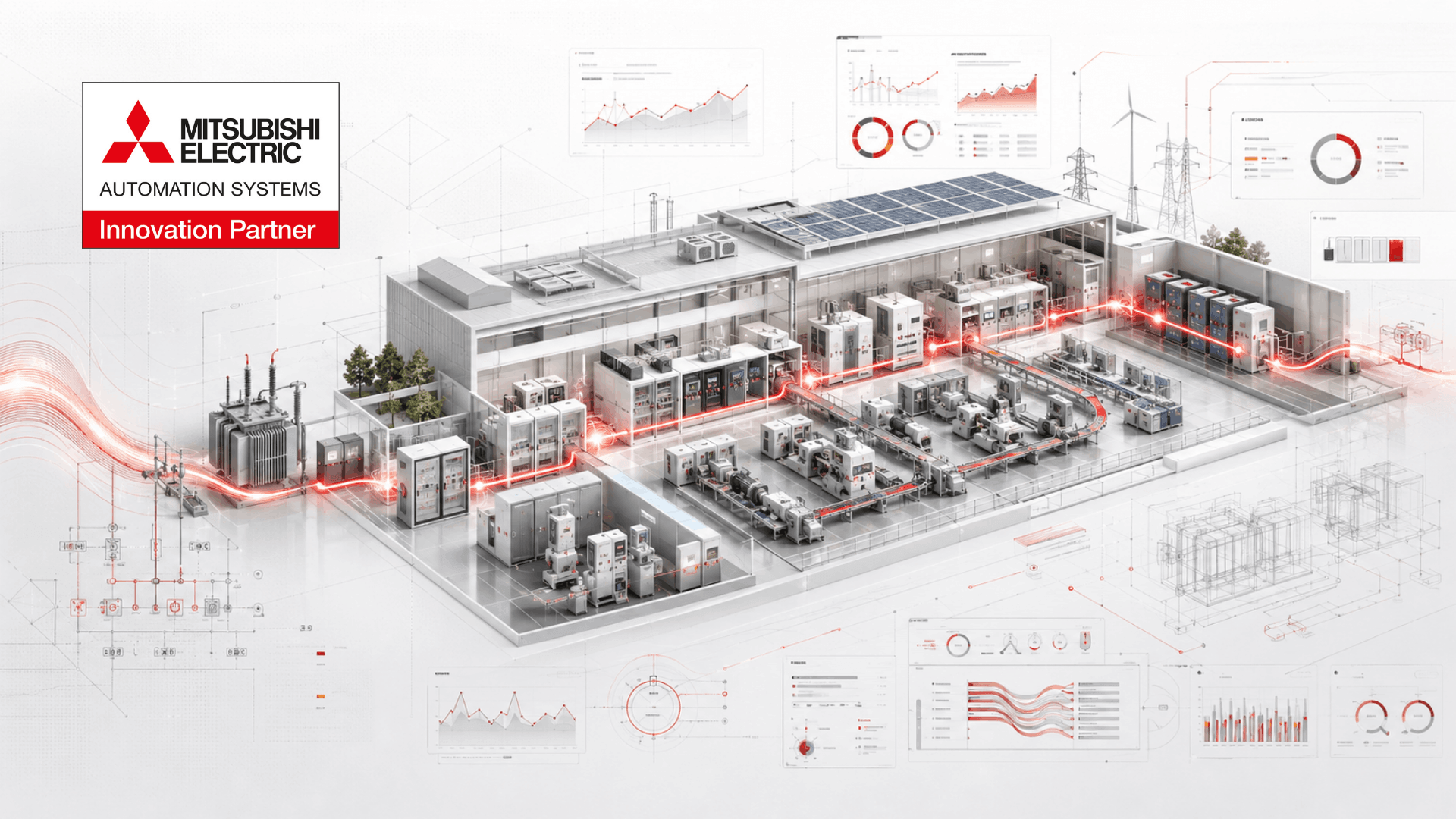
For modern UK manufacturers, energy is no longer just a line item on a utility bill, it is a core strategic pillar. Between the pressure to meet ambitious net-zero targets and the need to protect bottom-line margins from market instability, businesses are finding themselves at a critical crossroads.
As a proud Mitsubishi Electric distributor, CDL is committed to helping you navigate this changing landscape. Whether you are an Original Equipment Manufacturer (OEM) looking to build highly efficient machinery or an end-user striving to decarbonise your factory floor, understanding how to harness modern energy technologies is the first step toward lasting resilience.
To help you map out your strategy, we’ve broken down the path to sustainable manufacturing into four key areas: Energy on an Industrial Scale, Energy Systems, Energy Efficiency, and Energy Management.
- Energy on an Industrial Scale: The Macro Challenge
To understand why we must act locally, we have to look at the macro environment. UK manufacturing has weathered a historic storm.
In late 2022 and early 2023, the sector faced an unprecedented crisis. According to the trade body Make UK, soaring, “out of control” energy costs posed a serious threat to the survival of 6 in 10 manufacturing businesses. Wholesale gas and electricity prices spiked to levels never before seen this century.
While wholesale costs have thankfully fallen from those peak levels, they remain significantly elevated compared to the historical averages of the last decade. More importantly, the threat has not disappeared. Energy market analyst Cornwall Insight points out that extreme volatility in the wholesale energy market is highly likely to persist until at least 2030 unless industrial users make fundamental, structural changes to their long-term energy strategies.
For UK manufacturers, waiting for the market to stabilise is no longer a viable plan. True resilience requires taking control of your own energy footprint.
- Energy Systems: Striking the Balance
Every manufacturer’s energy journey is guided by four competing drivers, often referred to as the four pillars of industrial energy:
- Capacity: Ensuring your site has enough physical power to run operations.
- Cost: Minimising spend in a highly volatile market.
- Carbon Reduction: Meeting corporate and regulatory sustainability targets.
- Resilience: Protecting the site from grid instability and power outages.
Balancing these four drivers is notoriously difficult. To help manufacturers make evidence-based decisions, Mitsubishi Electric offers a suite of physical and digital tools tailored to wherever you are on your digital transformation journey:
- Upgrade physical machinery: Integrating high-efficiency automation equipment (Inverters, Servos).
- Understand consumption: Auditing and mapping how assets consume power in real time.
- Optimise operations: Deploying advanced software to eliminate waste and predict demand.
- Ensure grid independence: Moving partially off-grid with smart microgrids and battery storage (BESS).
By looking at energy as a unified system rather than isolated machines, businesses can transition from reactive energy buyers to active, resilient energy managers.
- Energy Efficiency: Upgrading the Hardware
In an era of rapid electrification, the most immediate way to protect your business is to make sure every kilowatt of energy is used as productively as possible. This is particularly true for intensive industries like manufacturing, where minor percentage gains quickly translate into thousands of pounds saved.
At CDL, we believe the most effective cost-reduction strategy uses a systematic, dual approach combining people and technology to ensure maximum return on investment in the shortest time.
Smart Hardware Solutions
Upgrading to high-efficiency components is one of the fastest ways to lower your asset energy profiles:
- Frequency Inverters: Modern drive technology from Mitsubishi Electric controls both standard induction motors and the latest IPM (Interior Permanent Magnet) high-efficiency motors. This drastically reduces energy use, even when applications are running at full speed.
- High-Performance AC Servos: The award-winning MELSERVO series is designed to minimise torque fluctuations using high-resolution encoders and advanced tuning algorithms. This significantly reduces machine cycle durations and saves substantial energy, earning it the prestigious Excellence in Energy-Saving Equipment and Systems Award in Japan.
Analytical Software Supporting the Hardware
EcoAdviser: Hardware is only as good as the logic driving it. EcoAdviser software uses powerful artificial intelligence (AI) to automatically identify and quantify energy losses, allowing maintenance teams to prioritise the most critical countermeasures.
- Energy Management: Turning Data into Action
It is a common Industry 4.0 paradox: manufacturers are drowning in data but starving for insights. Many businesses are highly confident in their net-zero aspirations, yet struggle to implement the operational tools required to achieve them.
This gap was highlighted in a global Net Zero Corporate Readiness Report by ENGIE Impact, which found a distinct disconnect between ambitious corporate carbon targets and the actual tools, talent, and technology deployed on the factory floor.
To bridge this gap, Mitsubishi Electric utilises a structured methodology called the Smart Manufacturing Kaizen Level (SMKL):
- Level A Collect: Hardware meters & PLCs gathering data
- Level B Visualise: Clear dashboards & Sankey diagrams
- Level C Analyse: Finding patterns & predicting issues
- Level D Optimise: Continuous AI-driven improvements
By encouraging manufacturers to “think big, but start small”, SMKL creates an incremental, risk-managed roadmap to net-zero that delivers a clear, provable ROI at every single stage.
The Energy Management Ecosystem
To build a complete digital picture of your facility’s energy usage, Mitsubishi Electric and CDL offer a fully integrated, scalable ecosystem:
- The Sensors & Collectors: Compact PLCs and the ME96 range of smart energy meters (supporting Modbus TCP/RTU) physically capture real-time electricity consumption across the shop floor.
- The Visualisation Engine: ICONICS Suite (Genesis64 and Energy AnalytiX) acts as the central brain. It integrates siloed data from Building Management Systems (BMS), ERPs, and control networks to create rich, real-time energy dashboards, Sankey flow diagrams, and digital twins.
- The AI Brain: MELSOFT MaiLab introduces predictive analytics, using AI to forecast energy consumption and automatically spot operational inefficiencies before they impact your bill.
Proven in the Field
Stallantis (Automotive): Used the ICONICS Suite to automatically detect real-time energy losses and deliver immediate action recommendations straight to operators on the floor.
Spirax Sarco: Deployed remote health monitoring for installed steam boilers, ensuring every asset operates in its optimum efficiency zone.
Microsoft HQ: Implemented an ICONICS-based, data-driven campus solution across 125 buildings, saving millions of dollars in utility and operational costs.
Your Next Steps toward Energy Resilience
No matter where your business currently sits on its energy journey, whether you need a basic building energy audit or are looking to design a self-healing microgrid system, taking a systematic, technology-led approach is the only way to build a truly resilient operation.
CDL is here to provide the hardware, software, and engineering expertise to help you build a smarter, more sustainable future. Get in touch today to learn more.